
FOR A GREEN ARCHITECTURE AND RESTORATIVE ECOLOGY:
A scalable growing system to supply green roofs and living walls with moss and lichen cover
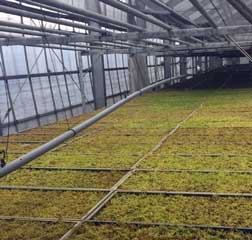
Mosses and lichens have many beneficial qualities that make them suitable for horticultural applications; however they are under-utilized in Canadian landscape architecture. Mosses and lichens lack extensive roots systems, and therefore do not require much soil. This means they could be applied to rooftops with little to no structural enhancement. The combination of small shoot-size with a colonial, mat-forming growth habit makes them amenable to applications ranging from small-scale, indoor greenery to large-scale outdoor rehabilitation projects. Adding mosses and lichens to the suite of green architecture species expands the market to include residential, as well as commercial structures, thereby increasing access to green roof esthetics and ecological services for all Canadians.
The “Moss Machine” growth chamber, is a multi-layered, low-cost rapid cultivation of mat-forming mosses and lichens over layers of organic fabric, resulting in blankets of live, desiccation-resistant vegetation. The space-saving requirements of advanced stacked-tray hothouse production systems will also be employed. We intend to take advantage of recent advances in small-scale LED grow-lighting systems to limit the cost and stressful temperature increases associated with halogen or fluorescent lighting in growth carts.
The results of the project will be (1) a prototype growth chamber (the Moss Machine) that can produce field-ready mats of moss and lichen species, (2) an ongoing field experiment to evaluate the persistence and rigour of moss mats on residential rooftops, and (3) a new resource for landscape architects to use in numerous applications.
UPDATES
2018.12_ Update: Drs. Haughian and Lundholm has completed their work and an article on their findings will be printed within the next few months, when published a link will be provided on the lacf.ca website. The Moss Machine study has demonstrated that mosses can be grown with ease in an indoor setting. The mosses from this first trial are now being field-tested on a green-roof, with survival and growth contrasted against wild-harvested material over several months. We look forward to additional testing of new watering regimens, lighting designs, and species combinations as we develop this valuable and under-utilized resource.
2019.07.12_ Final Report_ Moss for Article
2024_ Read a recent article on the research: Mosses for minimalist green roofs: a preliminary study of the effects of rooftop exposure, species selection, and lab-grown vs. wild-harvested propagule sources