
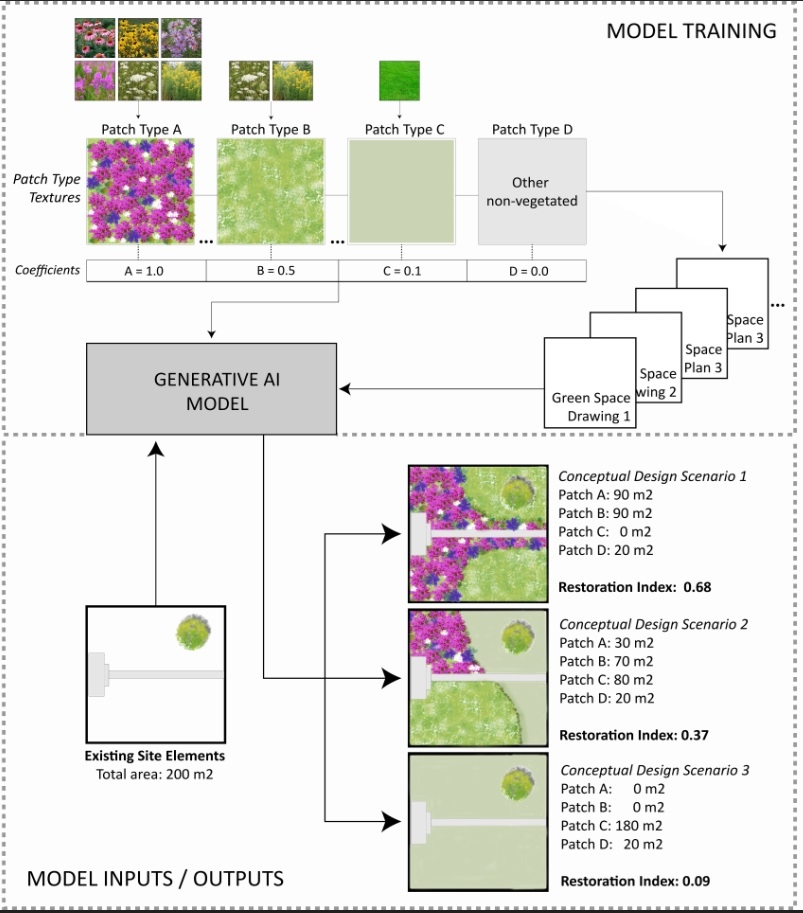
 Landscape architects work on multidisciplinary projects that require effective design decision-making and communication methods. Habitat restoration, for example, involves diverse objectives from professionals and the public that are sometimes in opposition (ecological value vs aesthetic preference). Here we leverage machine learning applications to improve inclusive design collaborations with an AI model for presenting and quantifying conceptual landscape design scenarios. Our goal is to train a model for automating conceptual green space designs that are supported by a quantitative ‘restoration index’. Through generating multiple designs, conceptual scenarios can be re-generated in response to feedback that supports the initial stages of design.
We would like to thank the Landscape Architecture Canada Foundation (LACF) for funding this project through the 2025 LACF Research Grants program. In this project, we developed the PHI-AI Landscape Design Tool that is proposed as an innovative generative AI system that helps landscape architects collaboratively explore greenspace design options while prioritizing ecological value. The tool rapidly produces alternative landscape layouts and ranks the habitat quality of each variation using an integrated Pollinator Habitat Indicator (PHI). By combining AI-generated design scenarios with ecological indicators and human-guided evaluation, the project presents an interactive design decision-making workflow that can enhance biodiversity, pollinator conservation, and community engagement. The tool leverages the efficiency of generative AI while keeping a human-in-the-loop approach to concept design. This work illustrates how landscape architects can integrate emerging digital tools with ecological science to support collaborative planning and problem-solving.